
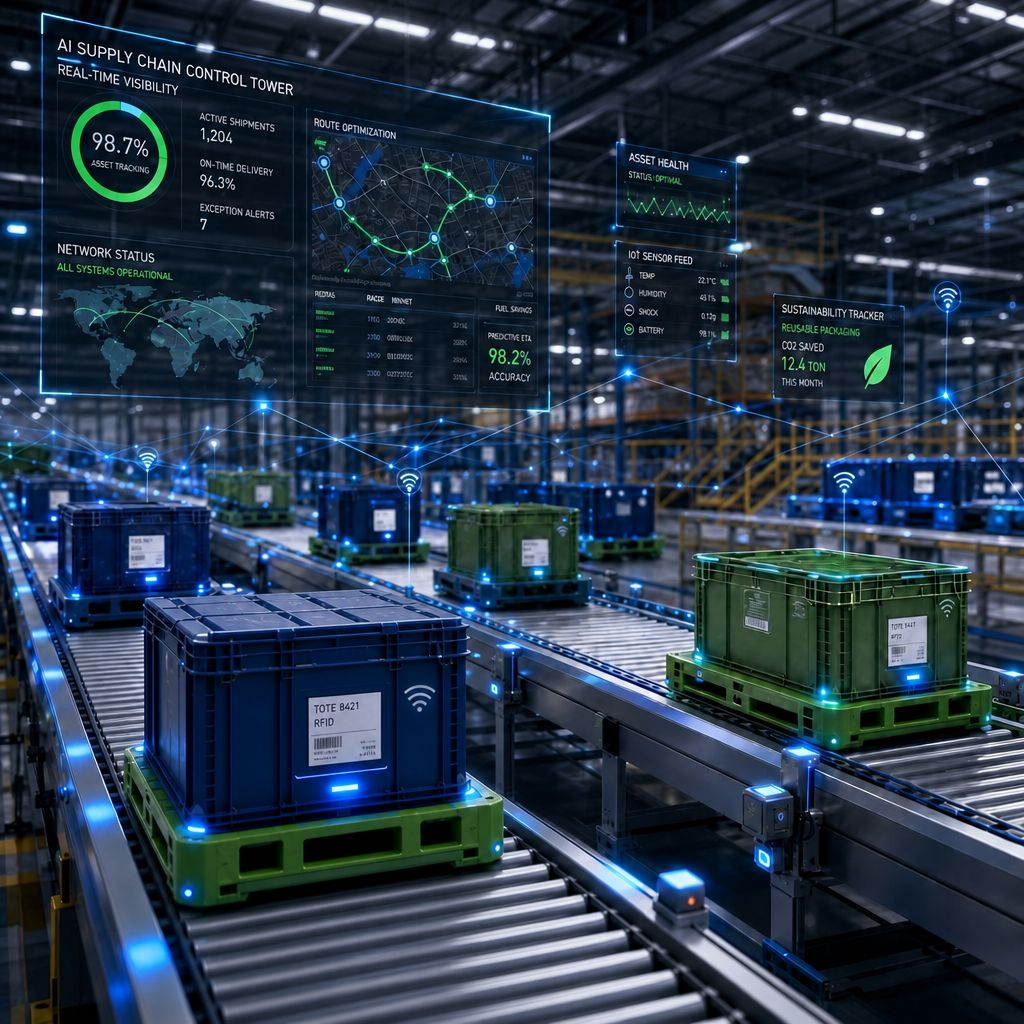
Reusable transport packaging (RTP) has always been built around a simple promise: the more you use it, the more you and the planet save. Pallets, totes, bins, and containers move the vast majority of commercial goods through supply chains, and they do it reliably. What they have not always done is talk back.
That is changing. As artificial intelligence (AI) becomes embedded in supply chain operations, reusable transport packaging is emerging as something more than a physical asset. Equipped with sensors and tracking technology, RTP generates the kind of structured, repeatable real-time data that AI systems need to generate accurate, trustworthy information for effective decision making. The result is a convergence of packaging performance and intelligence that benefits the entire chain of product custody, but only for organizations that take advantage of smart and connected RTPs.
Intelligent and AI-Enabled RTP Systems
When RPA President and CEO Tim Debus took the stage at PACK EXPO Las Vegas in September 2025, he made the case plainly: AI is advancing faster than most industries appreciate, and supply chain operations will be deeply impacted with new opportunities for data-driven efficiencies. His argument was not that AI applications are coming someday, but they are already being deployed reshaping how organizations forecast demand, plan supply, and move goods.
What makes this moment especially relevant for reusable transport packaging is the data dimension. AI systems depend on large volumes of accurate, timely information. Without it, even the most sophisticated algorithms fall victim to the familiar problem of garbage in, garbage out. RTP, because it circulates repeatedly through supply chains, generates structured and consistent data streams over time. That makes it particularly suited to power predictive analytics, loss prevention, asset utilization analysis, and regulatory traceability.
Three forms of AI are now actively entering this space. Standard AI analyzes operational data to support or automate decisions, shifting planning away from intuition and toward models informed by real-time asset-level information. Generative AI creates outputs like forecasts, summaries, and operational recommendations based on existing data. And agentic AI, the most advanced form, operates autonomously, reasoning through options and taking action without constant human input. Applied to technology-enabled RTP, agentic AI has the potential to adjust inventory positioning, reroute assets, or trigger recovery strategies based on live pallet or container data, without waiting for a person to notice a problem first.
That last point matters more than it might seem. Most supply chain losses are not dramatic. They accumulate quietly through dwell time, missed returns, and route inefficiencies that nobody catches in time. AI changes that equation.
AI and Smart Tracking in RTP
The intelligence of any AI system is only as good as the quality of the data feeding it. This is where smart tracking becomes the foundation, not an add-on.
When RTP assets are equipped with RFID tags, sensors, Bluetooth Low Energy beacons, or cellular IoT devices, they transmit continuous information about location, movement, temperature, and condition. That information flows into platforms that can identify patterns, flag anomalies, and trigger action, often before an operator is aware that anything has gone wrong.
Real-world results across the RPA ecosystem show what this looks like in practice: a bakery reduced losses of plastic bread trays by pinpointing route and customer-level inefficiencies, RFID-enabled plant trays allowed operators to capture data on thousands of containers simultaneously, and RPA members IFCO Systems and Real Time Intelligence embedded track-and-trace capabilities across IFCO’s North American RPC pool, giving growers and retailers live data on asset location, movement, and sanitation status throughout the fresh food supply chain.
The cellular technology enabling this is also maturing quickly. LTE-M and NB-IoT, both developed under the 3GPP standard for low-power wide-area connectivity, are reshaping what is possible for asset tracking. LTE-M suits assets in motion, maintaining connectivity at highway speeds across cell towers. NB-IoT is optimized for stationary or slow-moving assets in warehouse environments, where pallets and containers spend much of their time. Devices using both technologies can run up to ten years on a single battery, which changes the cost calculus significantly for tracking lower-value assets that were previously too expensive to monitor.
Data Visibility and Asset Intelligence
Knowing where an asset was last seen used to be enough. That standard no longer holds. Organizations are now using real-time sensor data to move from reactive to predictive, catching cold chain breaches, extended dwell times, and maintenance needs before they become service failures or revenue losses.
A McKinsey and Company study found that embedding AI in supply chain operations can deliver reductions of 5 to 20 percent in logistics costs, 20 to 30 percent in inventory levels, and 5 to 15 percent in procurement spend.
For reusable transport packaging specifically, the data advantage compounds over time. Because these assets circulate repeatedly, AI systems accumulate richer and more reliable training data with each cycle. An RTP asset becomes more intelligent and more valuable the longer it stays in service. That is a dynamic that single-use packaging simply cannot replicate.
Food traceability is one area where this potential is especially significant. Automated data capture through technology-enabled reusable transport packaging could dramatically reduce regulatory compliance costs and response times during product recalls, replacing manual documentation with continuous, verified digital records. As EY research notes, many supply chain executives are still reacting to disruptions rather than anticipating them, often because they rely on legacy ERP systems designed for batch processing that cannot meet real-time demands. A unified, data-driven approach to RTP asset management directly addresses that gap.
Still, it would be inaccurate to suggest the path is without friction. Debus acknowledged at PACK EXPO that many organizations have yet to see anticipated returns from AI investments, often due to data quality issues, integration challenges, and organizational readiness. The gap between AI experimentation and measurable impact is real. Closing it requires not just technology but a clear-eyed commitment to data infrastructure and cross-company collaboration.
Innovation and Technology Spotlights
The market is responding. The global RTP market with IoT tracking is projected to reach $4.55 billion by 2030. Pallets currently lead adoption, with established pooling networks that can provide a ready platform for technology-enabled retrofits. The WAN-connected returnable transport asset tracking market, covering pallets, containers, and bins using wide-area network connectivity, is projected to grow from $92.5 million in 2025 to $372.6 million by 2035, a compound annual growth rate of 12 percent, driven by AI-led asset monitoring, 5G expansion, and growing sustainability mandates.
Several platforms are already operating on scale. Project44, named a Leader in the 2025 Gartner Magic Quadrant for Real-Time Transportation Visibility Platforms for the fifth consecutive year, grew new annual recurring revenue by more than 40% in Q3 2025. FourKites, another recognized leader, supports more than 1,600 global brands and is moving customers from basic shipment tracking toward full supply chain orchestration through digital twins and workflow automation.
Inside the Reusable Packaging Association, the Technology Working Group is now leading industry-wide discussions and collaborative efforts focused on education and practical AI use cases for reusable packaging systems. For organizations looking to explore what technology-enabled RTP looks like in practice, the RPA Technology Map is a strong starting point, mapping typical use cases across the supply chain alongside real-world case studies contributed by Technology Working Group member companies. The association is also beginning to integrate AI into its own operations, with the goal of improving efficiency and delivering more value to members. As Debus put it, AI is not only a subject for industry discussion. It is a tool that will increasingly shape how nonprofit organizations like RPA operate and serve their constituencies.
The Direction Is Clear
Questions remain around standards, interoperability, data security, and what organizational readiness requires in practice. These are not small questions. But the industry’s direction is not in doubt.
AI is moving from experimentation into operational deployment, and reusable transport packaging, with its repeatable data flows, circular asset life, and central role in supply chains, is one of the most natural entry points for that deployment. The companies and organizations that invest now in quality data infrastructure, smart asset tracking, and AI-ready reusable packaging systems will not simply be more efficient. They will operate at a fundamentally different level of supply chain intelligence.
For the reusable packaging industry, that is not a distant possibility. It is already underway.